
Sema
The experience of watching Sema in Konya, Turkiye

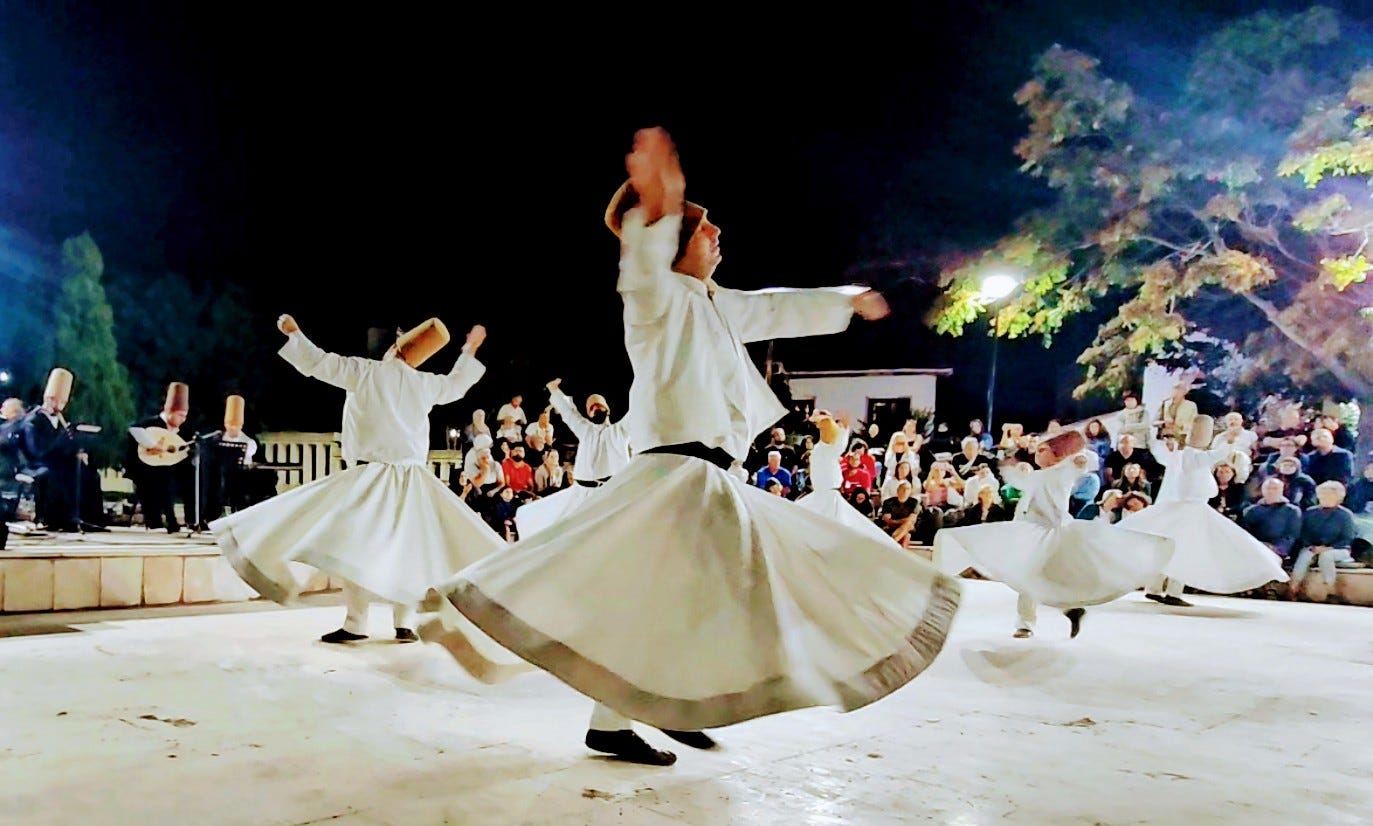
Have you ever seen the whirling dervish? The dance of love? The dance of spirituality! The dynamic meditation?
I had seen it before in documentaries and artwork and read about it, the fascination was real. I had connected it to a certain level of connection with God, tuning everything else out, as they whirl and focus on the depth of this human experience. Watching it in real life was an experience of its kind! And probably not what I expected.
Sema is a form of meditation ceremony. Close to at least a 700-year-old ritual that combines the whirling of the dervishes with the poetry of Rumi, Turkish classical music, and dhikr- remembering Allah - in the form of devotional prayers or recitations from the Quran.
We were lucky to find this place behind the Mevlana Museum in Konya, Turkiye, it is an open-air space dedicated to the practice of Sema every Thursday evening. Anyone can enter, everyone is welcome. We were fortunate to have found this place, it started as we sat down around the amphitheater.
Like a book, this meditative dance has several chapters and flows seamlessly from one part to the next. Sema is not just a performance; it is the celebration of the love of everything divine, an acknowledgment of the singularity of love and the sweet surrender it demands.
The ceremony is steeped in symbolism, from the camel hair hat the dervishes wear to their spinning in repetitive circles, from the position of their hands to the motions performed. I had to look it all up later as I found myself unsure of what I was watching and how it related to the Sufi-Mevlevi order. There is so much more, that an article, perhaps even a book cannot capture. ( A simplistic explanation can be found here https://sufism.org/origins/mevlevi/sema-illustrated/the-sema-ceremony-11 )
And as a novice I just sat there, watching, mesmerized, captivated and wondering if this was a form of art or a form of prayer, or both. Did Mevlana Rumi intend it to be this way? The rituals we see today, as protected by UNESCO Cultural Heritage, are said to have been formulated years after Rumi’s death, likely by his son Sultan Valed. Also are they in line with the mainstream religion?
And then I was reminded of Rumi’s verses-
Out beyond ideas of wrong and right,
There is a field. I'll meet you there.
When the soul lies down in that grass,
The world is too much to talk about.
Ideas, language, even the phrase each other
Doesn't make any sense.
And I thought to myself, I am wanting to know how the ocean feels by looking at it! By thinking about it, by reading about it, by watching the waves and hearing them crash. You cannot truly know the experience of being one with the ocean if you have never stepped foot in it!
-The the origin Sema is credited to Rumi- the 13th century Persian poet and one of the greatest Sufi mystics the world has ever known.
-The Mevlevi- a sufi order dated back to 1273 in the city of Konya the then capital of central Anatolian region of Turkey
I could also feel it with you as if I am watching it 😇so that’s a great write up then !